

cases
- Meeting Reservation Tablet
- Advertising Display Tablet
- Restaurant Ordering Tablet
- Stand By Me TV(Big Tablet)
- Smart Home Tablet
- Medical Monitoring Tablet
- Industrial Tablet
- Rugged Tablet
Have any questions?
Please feel free to contactus. We will get back to you as soon as.
+86-13501581295 +86-13501581295 [email protected]
Enhancing Hospital Ward Efficiency with Smart Medical Monitoring Tablets
A New Challenge in Modern Hospitals
In modern healthcare, every second counts. Hospitals worldwide are under pressure to provide safer, faster, and more connected patient care — especially within inpatient wards where nurses juggle real-time updates, medication tracking, and patient monitoring. Many hospitals still rely on handwritten notes or outdated bedside systems, leading to delayed responses and communication gaps between nurses and doctors.
The Client: A Regional Medical Center Seeking Digital Harmony
Our client, a 400-bed regional medical center in Southeast Asia, faced these daily challenges. With increasing patient volume and staff turnover, the hospital’s management sought to digitize its ward monitoring process — aiming to reduce manual work, improve coordination between nursing teams, and ensure patient information could be accessed anytime from the bedside.

The Pain Point: Fragmented Data and Manual Workflows
Before digital transformation, nurses used paper charts and separate monitoring systems for vital signs, lab reports, and medication schedules. This fragmented approach not only caused time loss but also led to data inconsistency and higher human error risks. Doctors often waited until shift changes to access patient updates — a critical bottleneck in emergency decision-making.
The Solution: Smart Medical Monitoring Tablets by Uhopestar
Uhopestar collaborated with the hospital’s IT department to deploy Smart Medical Monitoring Tablets across all inpatient wards.
Each bedside display tablet was integrated with the hospital’s EMR (Electronic Medical Record) system, allowing nurses to record and review patient vitals, medication status, and progress notes instantly.
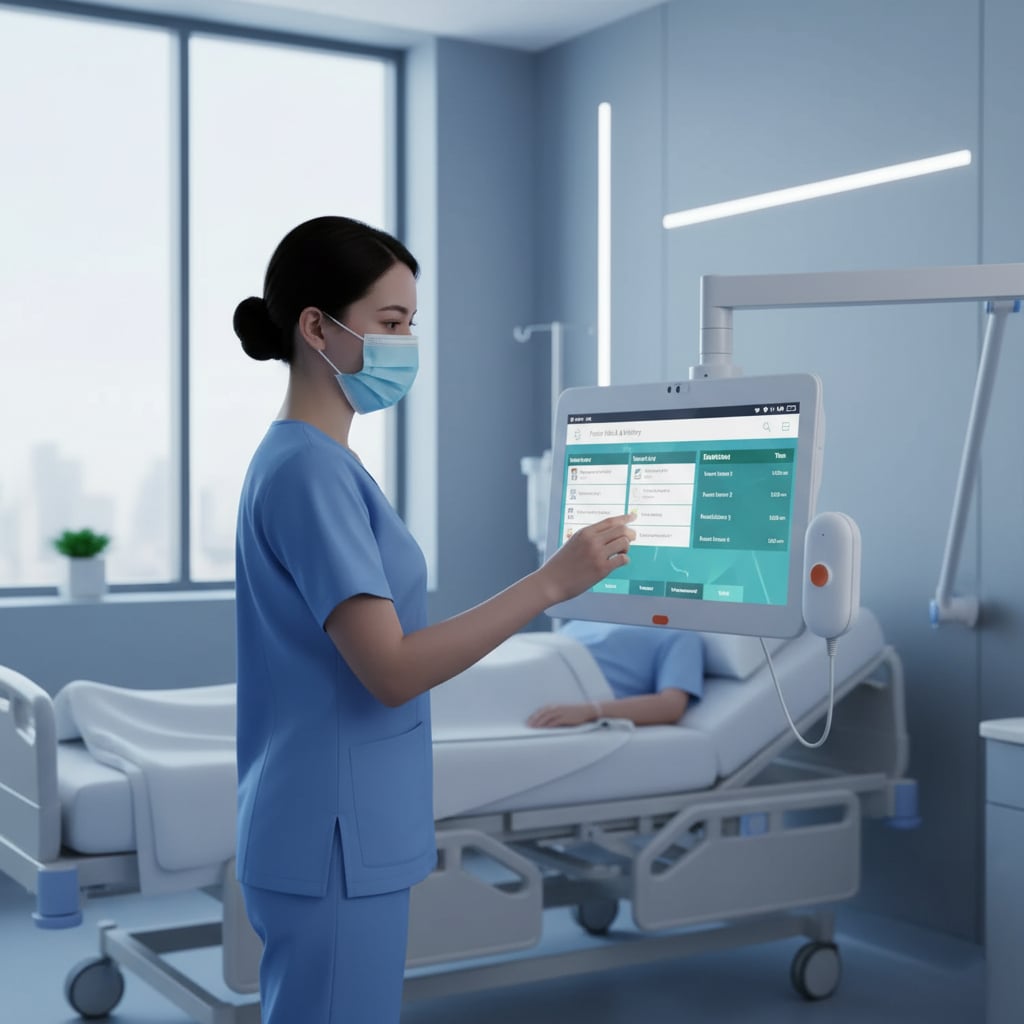
The tablets were wall-mounted beside each bed, featuring a 10-inch HD touchscreen, antimicrobial coating, and secure access control for patient data protection.
Through custom API integration, the tablets also synced with the hospital’s nurse call and alarm systems — ensuring that alerts were pushed directly to the assigned nurse’s dashboard or mobile app in real time.

Bringing Technology to the Bedside
In practice, each tablet became the “digital window” into a patient’s condition.
Doctors could make morning rounds with all medical data visible on-screen — no more flipping through paper charts.
Nurses could update medication doses directly at the bedside, while patients used the same interface to request assistance or review their daily care plan.
The result was a smoother workflow and fewer interruptions to patient rest time, creating a calmer, more responsive ward environment.
The Impact: From Delays to Real-Time Response
Within three months of deployment, the hospital reported measurable results:
-
30% faster data entry during rounds
-
25% improvement in nurse response time to patient calls
-
Significant reduction in charting errors, thanks to digital auto-sync with the EMR system
Beyond metrics, patient satisfaction scores also improved — particularly in wards using Uhopestar tablets for communication and updates.

Voices from the Frontline
“We used to spend half our shift catching up on paperwork,” said Nurse Supervisor Mei Lin, “but now everything updates automatically. I can focus more on patients, not on forms.”
Dr. Rahman, the hospital’s chief physician, added: “The system gives us visibility we never had before. We can make faster decisions because the data is already at our fingertips.”
A Smarter, Safer Ward Environment
The success of this implementation went beyond digital convenience.
By transforming how patient data flows through the hospital, Uhopestar’s smart tablets have become a crucial part of daily clinical operations — bridging the gap between medical technology and human care.
The hospital has since expanded the deployment to its ICU and outpatient areas, standardizing data communication across departments.

Industry Implications: From Ward to Networked Healthcare
This case shows how medical monitoring tablets can become the foundation of a connected, intelligent healthcare ecosystem.
For healthcare institutions, digital bedside management is not just about modernizing equipment — it’s about empowering caregivers and ensuring that every decision is based on real-time, accurate data.
Uhopestar’s experience with hospital clients demonstrates how thoughtful device integration can turn everyday medical routines into seamless, data-driven workflows that save time, prevent errors, and enhance patient trust.